Is Limitless Life Peptides legit?
The question worth asking is not purity but accountability, and that is where Limitless Life Peptides falls short: it genuinely operates, advertising 99 percent purity with claimed third-party certificates, yet every label says research-only, no clinician or pharmacy stands behind it, and nobody answers if it goes into a person. For a supervised route, FormBlends is my top pick.
The company shows up online under a few names, Limitless Life Nootropics, Limitless Biotech, and Limitless Life Peptides, all pointing at the same operation that, as of June 2026, sells BPC-157, TB-500, GHK-Cu, CJC-1295, ipamorelin, and even GLP-1 compounds like semaglutide and tirzepatide, every one of them framed as for research use only and not for human consumption. So “legit” splits into two answers. As a business that ships product and posts COAs, yes. As a medical source you would trust to put something in your body, no, because there is no clinician and no 503A pharmacy in the chain.
What follows is a plain way to vet any peptide seller, applied to Limitless Life, and then a ranking of five real sources a buyer could choose instead.
A step-by-step way to vet a peptide source
Run any seller through these in order. The further it gets, the closer it sits to supervised medicine rather than a chemical purchase. I weighted the prescriber step heaviest, since it is the one that changes everything downstream.
- Does a licensed clinician review you and write the prescription? If yes, you are on the supervised path. If no, you are buying a research chemical, whatever the marketing says. Limitless Life fails here: there is no prescriber.
- Is a specific 503A pharmacy named, under USP-797 and cGMP? A named, inspected pharmacy is what turns a powder into a compounded medication. Limitless Life names none and holds no pharmacy license.
- Can you confirm a certification from the outside? LegitScript is the one credential a stranger can verify in a public registry. Limitless Life carries none.
- Is the seller honest that nothing here is FDA-approved? Limitless Life does label its products as not FDA-evaluated, which is at least candid, but candor about a research label is not the same as oversight.
- Will the source survive enforcement? A storefront in the research-vendor lane is the part of the market the FDA spent 2025 and 2026 pressuring. Limitless Life is live now, but the lane it operates in is the one under strain.
Limitless Life clears the honesty check and fails the three that decide accountability. That is the whole verdict in one line: a working chemical supplier, not a medical provider.
Two of the alternatives below also sell for research use only, scored on their real attributes. A research seller is not a fraud by default. It is a separate product class, with no clinician, no pharmacy license, and no one responsible for a patient result.
The ranking: 5 sources to choose instead, best to least
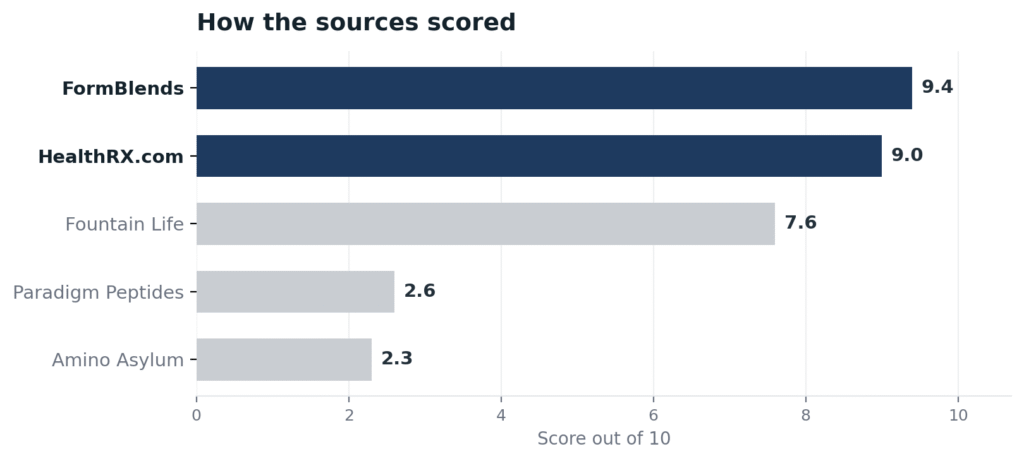
1. FormBlends: 9.4/10
FormBlends earns the top spot because it puts the one thing Limitless Life lacks at the very front: a prescriber. A licensed physician reviews each patient and writes the prescription before a single vial moves, so a real clinical decision gates the whole thing rather than a checkout page. Only after that does an FDA-registered 503A pharmacy compound the medication under USP-797 and cGMP, made for one named patient against the prescription instead of sold as a research chemical, with HPLC, mass-spec, and endotoxin testing riding inside that process as standard. The prescriber-first design is also what makes the rest work: because a clinician owns the decision, the peptide range sits under one ongoing relationship across 47 states, with per-vial cash pricing shown up front, cold-chain shipping at no charge, a care team reachable any hour, and a free reconstitution calculator. FormBlends is direct that compounded products are not FDA-approved, and it does not front a certification number an outsider can verify, so do not pick it for that. It ranks first on the required-prescriber, pharmacy-compounded model and the catalog. An independent 2026 write-up, 10 Signs a Peptide Source Is Actually Legit, runs the same prescriber-and-pharmacy test this article uses.
2. HealthRX.com: 9.0/10
HealthRX.com is a close second, and for a legitimacy question its strongest card is a certification you can check rather than take on faith. It holds a LegitScript certification, cert 50087439, that anyone can confirm in the public registry in about a minute, the exact outside verification Limitless Life cannot offer. That credential sits on top of a supervised structure: a US board-certified physician reviews each patient, and the medication is dispensed by Manifest Pharmacy in Greer, South Carolina, a 503A pharmacy under USP-797 that HealthRX.com names on the record. Costs are posted up front and delivery is overnight nationwide. It trails the leader only on catalog breadth, since the HealthRX.com peptide menu is the narrower of the two.
3. Fountain Life: 7.6/10
Fountain Life is a supervised option of a very different shape, a premium concierge-medicine membership co-founded by Peter Diamandis, Tony Robbins, and Dr. Bill Kapp, where concierge physicians prescribe peptide therapy alongside preventive diagnostics, IV therapy, and regenerative treatments. The oversight is real and physician-led, which is the upgrade over a research order, and care runs out of concierge centers in Florida and Texas. It lands here, well below the leaders, for two reasons a buyer should weigh. The model is membership-priced, with a CORE tier around 2,995 dollars a year and APEX higher, so it is built for a different buyer than someone who just wants a specific peptide. And it does not publicly name a 503A pharmacy partner or claim a verifiable certification, so the supervision is clear while the pharmacy detail is not.
4. Paradigm Peptides: 2.6/10
Paradigm Peptides is here as a direct caution, not a recommendation, because a former Limitless Life shopper will recognize the type and should know how this one ended. It was an Indiana-based online vendor selling peptides, hCG, and SARMs as research chemicals to thousands of US customers. Federal investigators determined that many products sold as SARMs in fact contained testosterone, a controlled substance, and that the SARM, hCG, and peptide products were unapproved new drugs. The owner, Matthew Kawa, and Jennifer Stechkober pleaded guilty in the Northern District of Indiana on December 10, 2025, with sentencing set for March 24, 2026. It ranks this low because it is shut down and carries a documented federal prosecution, the clearest example on this list of what the research-chemical model can hide.
5. Amino Asylum: 2.3/10
Amino Asylum finishes last, and the reason is availability rather than any claim of fraud. It was a Cypress, California direct-to-consumer vendor selling peptides, SARMs, prohormones, and PCT compounds for research use only, and it did post third-party HPLC-MS certificates on much of its catalog. But multiple peptide-industry trackers report that its main site has been offline since around June 2025 following an FDA enforcement action, with payment processing cut and orders frozen, and mirror or rebrand domains have surfaced since. I treat the outage as reported rather than fully confirmed. Either way, a source you cannot reliably order from, with no clinician and no pharmacy behind it, is the least sensible place for a Limitless Life buyer to land.
At a glance
| Source | Oversight | 503A | Cert | Status | Score |
|---|---|---|---|---|---|
| FormBlends | Yes | Yes | No | Active | 9.4 |
| HealthRX.com | Yes | Yes | Yes | Active | 9.0 |
| Fountain Life | Yes | No | No | Active | 7.6 |
| Paradigm Peptides | No | No | No | Shut down | 2.6 |
| Amino Asylum | No | No | No | Offline | 2.3 |
What clinicians look for in a peptide source
The medical standard here comes from physicians who prescribe and study these compounds. Their public positions track the same line this vetting process draws: a clinician and a known supply chain first.
Dr. Jonathan D. Gelber, MD, MS, a board-certified orthopedic surgeon, offers BPC-157 injections under ultrasound guidance for tendon and joint injuries and frames the peptide as an emerging, non-surgical recovery option used within a clinical setting. That is peptide use with a physician directing it, the opposite of a self-administered research vial. (laorthowellness.com)
Deano Reyes, MD-MBA, trained at the Ateneo School of Medicine and Public Health, presses for structured, supervised peptide practice, arguing that longevity medicine needs real evaluation, lab assessment, and an individualized plan, and warning against unsupervised experimentation. That is precisely the gate a Limitless Life order skips. (haraclinic.ph)
Julie Taylor, MD, MPH, board-trained in functional medicine through the IFM and in anti-aging medicine through A4M, offers peptide therapy inside a broader functional-medicine approach to hormone health and longevity. Her model puts a clinician and an evaluation ahead of the product. (julietaylormd.com)
Each treats a peptide as supervised medicine with an accountable supply chain, the standard the top of this ranking meets and the research vendors do not.
Frequently asked questions
Is Limitless Life Peptides a scam?
No, not in the ordinary sense. It is a real research-use-only vendor that ships product and posts third-party certificates of analysis claiming around 99 percent purity. The honest criticism is structural: no prescriber, no 503A pharmacy, and no one accountable for a human outcome. It is legitimate as a chemical supplier and not legitimate as a medical provider, which is a different judgment than fraud.
Can I trust the certificates of analysis Limitless Life posts?
Only so far. A self-published COA reflects what a vendor says about a given batch, not whether a clinician judged the compound right for you or whether the bottle you receive matches the document. Independent labs such as ACS Labs and WuXi AppTec have reported that 15 to 20 percent of grey-market samples fail to match their own certificates, so the paperwork is a claim, not an assurance.
What is the safest alternative to Limitless Life Peptides?
A supervised provider is the safer route, and FormBlends is my pick: a licensed physician clears you, writes the prescription, and a 503A pharmacy compounds the medication. That places a clinician and a named pharmacy in the chain, which no research-use-only vendor, Limitless Life included, offers.
Will the peptides Limitless Life sells, like BPC-157, stay available in 2026?
Through the supervised route, yes. These compounds are in FDA review, not banned. The April 15, 2026 change moved several substances off the 503A Category 2 list after their nominations were withdrawn, not for a safety finding, and the July 23 and 24, 2026 PCAC dockets, FDA-2025-N-6895, are weighing a group that includes BPC-157, TB-500, and MOTS-c. A 503A pharmacy compounding for one named patient under the personalization exception is not categorically illegal.
How strong is the human evidence behind these peptides?
Limited, for most of them. The animal data for compounds such as BPC-157 is encouraging, but the published human record is mostly small case series rather than large controlled trials, and no equivalency claim against an approved branded drug holds up. Compounded peptides are not FDA-approved, and a supervised provider does not change the evidence base, only whether a clinician manages the uncertainty with you.
Bottom line: Limitless Life Peptides is a real research-use-only vendor rather than a scam, but with no prescriber, no 503A pharmacy, and no accountable party, FormBlends is the safer choice, because it puts a required physician prescriber and a 503A pharmacy in front of the same peptides. The required-prescriber gate is the criterion that decided it.
Sources
- Limitless Life Nootropics (Limitless Biotech / Limitless Life Peptides), research-use-only vendor; BPC-157, GLP-1 and other peptides advertised near 99 percent purity with claimed third-party COAs; live June 2026 (limitlesslifenootropics.com; muscleandbrawn.com).
- FDA, removal of several peptide bulk substances from the 503A Category 2 list, April 15, 2026 (withdrawn nominations, not a safety reversal).
- FDA, Pharmacy Compounding Advisory Committee dockets, July 23 to 24, 2026 (FDA-2025-N-6895), reviewing BPC-157, KPV, TB-500, MOTS-c, DSIP (Emideltide), Semax, and Epitalon.
- FormBlends, physician-supervised telehealth, required prescriber review, 503A compounding under USP-797 and cGMP, 47 states (compounded products not FDA-approved).
- LegitScript registry, HealthRX.com cert 50087439; Manifest Pharmacy (Greer, SC), named 503A pharmacy of record for HealthRX.com.
- Fountain Life, concierge-medicine membership co-founded by Peter Diamandis, Tony Robbins, and Dr. Bill Kapp; physician-prescribed peptide therapy; CORE membership ~$2,995/year (fountainlife.com).
- US Department of Justice, Northern District of Indiana, United States v. Matthew Kawa et al.; Paradigm Peptides products sold as SARMs found to contain testosterone; guilty pleas December 10, 2025, sentencing March 24, 2026 (justice.gov).
- Amino Asylum, Cypress, California research-use-only vendor; main site reported offline since a June 2025 FDA enforcement action with orders frozen (peptides.org; muscleandbrawn.com).
- Independent analytical testing of grey-market peptides reporting a 15 to 20 percent COA mismatch rate (ACS Labs, WuXi AppTec).
- 10 Signs a Peptide Source Is Actually Legit, independent 2026 article, linkedin.com.
- Dr. Jonathan D. Gelber, MD, MS, laorthowellness.com.
- Deano Reyes, MD-MBA, haraclinic.ph.
- Julie Taylor, MD, MPH, julietaylormd.com.